Sciage des métaux : savoir-faire en matière de production
Pneumatic Automatic Steel Pipe Sawing Machines: The Practical Buyer's Guide
A pneumatic pipe saw is dependable until the air supply, the blade or the clamping system lets it down. Ce guide explique comment ces machines fonctionnent, où elles s'intègrent réellement et ce qu'il faut vérifier avant d'acheter.
At eight in the morning, a 60 mm hydraulic cylinder tube moves into the clamping jaws of the shop's pneumatic automatic saw. Une simple pression sur un bouton et le circuit pneumatique serre le tuyau, avance la lame et ramène la tête. For the first two hours the rhythm is clean: square ends, small burrs, a neat stack of blanks. By mid-afternoon the cycle slows, the lower edge of the cut starts tearing, and the operator reads the air gauge more often than the workpiece. La machine n’est pas tombée en panne subitement ; le magasin a tout simplement dépassé les hypothèses intégrées à son alimentation en air.
The conclusion is worth stating early: a pneumatic automatic steel pipe sawing machine is a low-cost, dependable production tool when three conditions hold — adequate air volume, a blade matched to the wall thickness, and a clamping system that grips the pipe on both sides of the saw path. Lorsque l’un de ces éléments glisse, la machine commence à décider de votre qualité.
What a Pneumatic Automatic Steel Pipe Sawing Machine Actually Does
"Pneumatic" means the machine uses compressed air to drive the mechanical functions around the cut — typically the horizontal clamp, the vertical clamp, and sometimes the material stop or the blade feed. The saw blade itself is driven by an electric motor; le système pneumatique séquence le cycle de coupe.
Un cycle automatique typique ressemble à ceci :
- Le tuyau avance jusqu'à une butée de longueur.
- Un vérin pneumatique ferme la pince horizontale contre le tuyau.
- Un deuxième cylindre applique une pression verticale juste derrière la ligne de coupe.
- La tête de scie avance et termine la course de coupe.
- The head returns, both clamps release, and the finished piece drops to the discharge table.
- La pièce suivante avance et le cycle se répète.
« Automatique » dans ce contexte signifie répétable, pas nécessairement précis. The machine removes the operator's influence from clamping pressure and feed timing, but it still depends on a stable air supply. Most machines are rated for 0.4 to 0.6 MPa at the inlet. If the compressor cannot hold that pressure during the clamping and feeding stroke, every cycle runs longer and the blade pushes instead of cuts.
La consommation d'air est un critère de conception et non une note de bas de page. A pneumatic pipe saw cycling eight to ten times per minute can draw 120 to 180 litres of free air per minute, and few shops have only one pneumatic machine. Size the compressor, the receiver tank and the line diameter before the saw arrives.
Où les machines à scier les tuyaux pneumatiques conviennent le mieux
In practice, pneumatic pipe saws earn their keep in three situations:
- Répétition sur un seul diamètre. When the same tube size and wall thickness run for whole shifts, the pneumatic cycle applies identical clamp pressure and timing to every piece.
- Coupe d'angle pour cadres et mains courantes. Machines with a pivoting head or a rotary table repeat the same mitre cut for structural and architectural steel work.
- Short-batch production in fabrication and maintenance shops. Le changement est rapide, la machine est facile à comprendre et le coût d'investissement reste bien inférieur à une installation CNC.
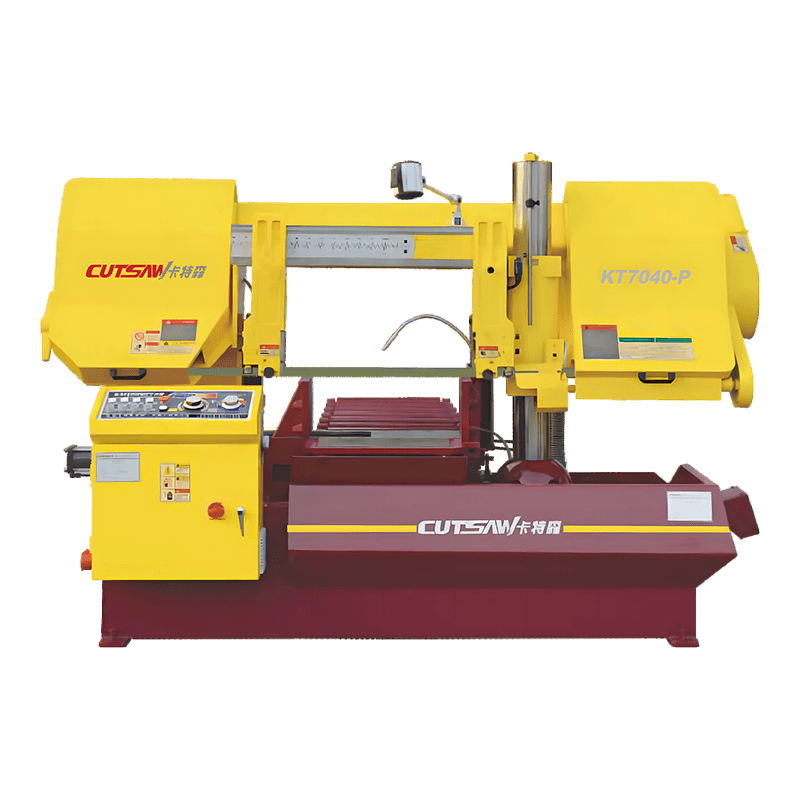
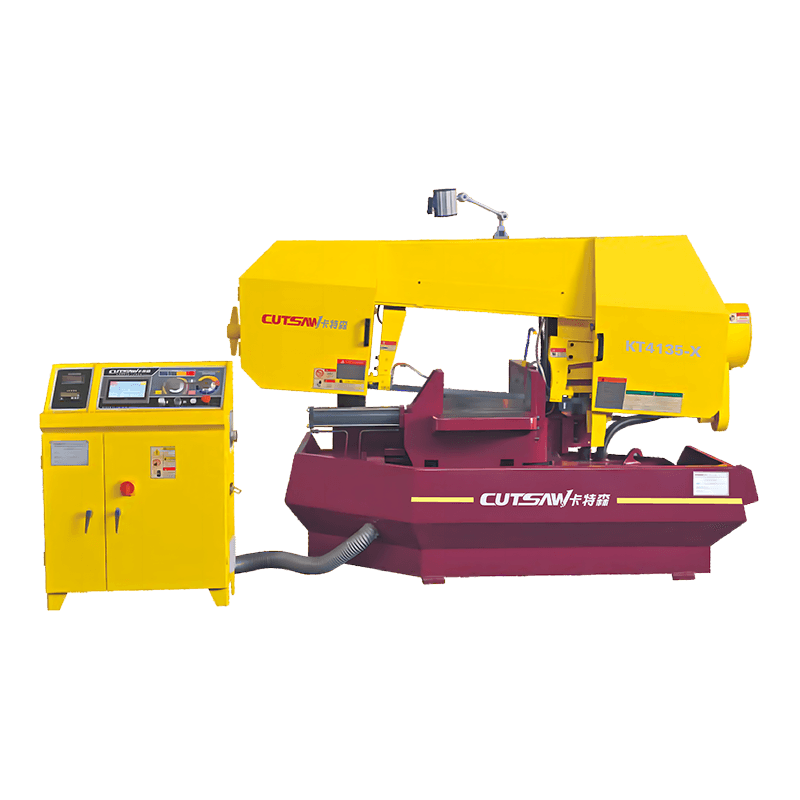
Les limites sont tout aussi claires. Les volumes très élevés dépassent la vitesse du cylindre ; very low volumes make the length-stop setup feel wasteful; and thick-wall pipe — roughly beyond an 8 to 10 mm wall — demands a feed force that a pneumatic cylinder cannot hold constant across the width of the cut. For shops that want a band saw dedicated to pipe work, a semiautomatic hydraulic pipe-cutting band saw such as the KT7040P removes air-pressure sensitivity from the clamping equation entirely.
La plupart des problèmes de sciage de tubes ne sont pas des problèmes de lame. Ce sont des problèmes de serrage et de pression. If the pipe can move while the blade is cutting, no blade will fix the finish. — Responsable de maintenance, atelier de fabrication métallique
Pneumatic vs Hydraulic vs Servo: What Changes in Production
La classe de machine importe moins que le comportement de la force d’avance. The table below compares the three common architectures for automatic pipe and bar sawing. Les tolérances sont des références en atelier et non des garanties du fabricant.
| Caractéristique | Vérin pneumatique | Système hydraulique | Servomoteur / variateur CNC |
|---|---|---|---|
| Comportement de la force d'avance | Varie en fonction de la pression atmosphérique et de la charge | Force constante et réglable | Couple et vitesse d'avance programmables |
| Stabilité de coupe | Modéré ; sensible aux chutes de pression | Bien | Excellent |
| Durée de vie de la lame | Cela dépend de la consistance de l'air | Prévisible | Plus cohérent avec une disponibilité élevée |
| Énergie et entretien | Faible énergie ; unités FRL de service | Entretien de l'huile et de la pompe | Coût initial plus élevé ; faible coût de fonctionnement |
| Tolérance de longueur typique | /-0,5 à 1,0 mm | /-0,2 à 0,5 mm | /-0,1 à 0,3 mm |
| Meilleur ajustement | Tirages courts et moyens, paroi fine à moyenne | Séries lourdes, de grand diamètre et longues | Multi-diameter batches, angle programs, unattended operation |
Il ne s’agit pas de rejeter la pneumatique. It is to match the machine architecture to the cut list. A pneumatic automatic steel pipe sawing machine is often the correct first machine; a servo-fed band saw is often the correct second machine. De nombreux magasins proposent les deux.
Five Checks Before You Buy a Pneumatic Automatic Steel Pipe Sawing Machine
- Auditez d’abord l’infrastructure aérienne. Confirm compressor capacity, receiver volume, dryer, filter-regulator-lubricator units and line diameter. A machine that needs 0.4 to 0.6 MPa at the inlet will not perform on a line that drops below 0.45 MPa under load.
- Inspectez la disposition de serrage. La machine doit maintenir le tuyau des deux côtés du chemin de scie. Single-clamp designs let the pipe vibrate during breakthrough and raise burrs on the exit edge. Check jaw length and clamping stroke against your full pipe OD range.
- Regardez la tête de scie, pas l'autocollant. La rigidité du châssis, la largeur du faisceau de guidage, la taille des roues de lame et la qualité de la boîte de vitesses déterminent davantage les performances que la puissance nominale du moteur. Un gros moteur boulonné sur un cadre léger ne coupera pas droit.
- Confirmez que la vitesse d'alimentation est réglable. Vous avez besoin d’une avance rapide vers le tuyau, d’une alimentation contrôlée à travers le mur et d’un retour rapide. A single-speed feed makes it harder to adapt to different wall thicknesses.
- Vérifier la documentation de sécurité et de conformité. CE marking, blade guard, interlocked covers, an emergency stop and a proper manual. Ask for the documents before you ask for the price.
A larger motor rating than the frame can structurally support is a red flag, not a benefit. The mass of the saw head, the width of the guide beam and the quality of the castings decide cutting performance over the life of the machine.
N’utilisez jamais une scie à tubes sans un protège-lame fonctionnel et un arrêt d’urgence. Pneumatic cylinders can fail in either position, so the guard is the second line of defence. Equipment without CE documentation should be excluded regardless of price.
Blade Selection, Burrs and the Cuts That Fail Inspection
Steel pipe is an interrupted cut: the blade passes through two walls and an empty centre, which makes tooth pitch more important than blade speed. A practical rule is to keep at least three teeth in contact with the wall at any moment. For typical pipes with 3 to 8 mm walls, a variable-pitch bimetal blade in the 4/6 or 5/8 teeth-per-inch range is a common starting point; thin-wall tube needs a finer pitch, around 10/14 TPI, to avoid tooth stripping.
La plupart des défauts de coupe ont les mêmes causes profondes. Une découpe inégale signifie généralement que la lame s'écarte des guides usés, qu'elle est soumise à une pression d'alimentation excessive ou qu'elle est émoussée. Les bavures de sortie signifient que la pince du côté éloigné est trop faible. Deformed pipe ends mean the vertical clamp is crushing the tube before the cut begins. For circular saw machines the same physics applies; the practical adjustments are covered in our guide on how to solve the uneven cutout of metal circular saws.
Blade life on a pneumatic machine is also an air-supply issue. If the feed cylinder pushes harder as line pressure climbs at the end of the compressor cycle, the teeth load unevenly and flat spots appear. Slowing the feed just before breakthrough is the single most effective habit for extending blade life.
When Pneumatics Are Not Enough: Realistic Upgrade Paths
Every pneumatic pipe saw eventually meets its workload ceiling. La décision de mise à niveau devrait provenir de la liste de coupe, et non de la pression commerciale. Trois modèles sont courants :
Quand le volume dépasse une seule équipe
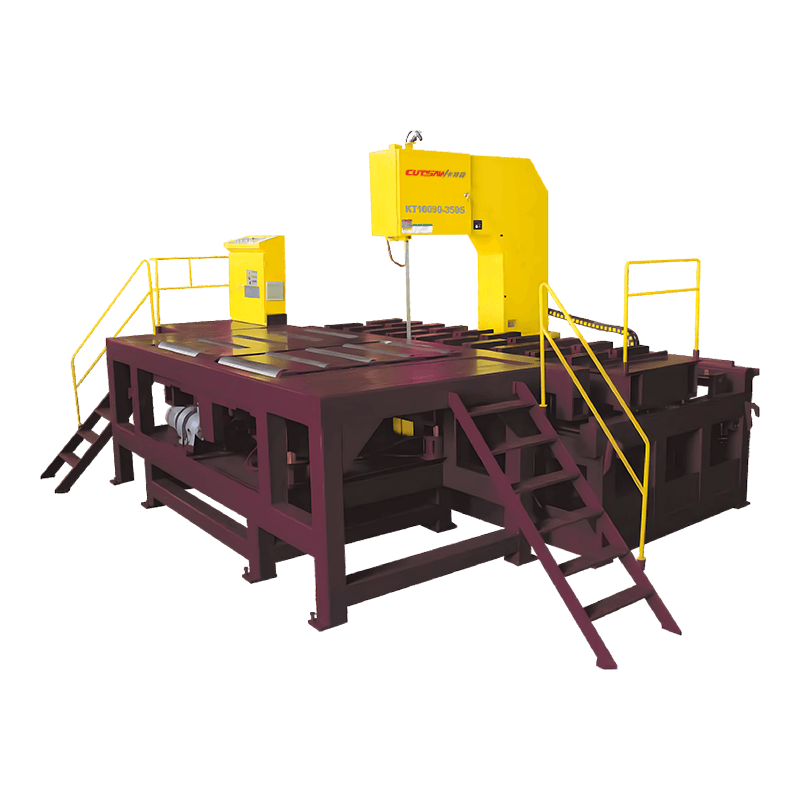
A hydraulic double-column saw removes the air-pressure dependency and runs continuously with predictable blade life. For large diameters and heavy walls, the double-column construction keeps the head from twisting; the ultimate guide to double-column band sawing machines explains the structural reasons in detail.
When the Customer Wants a Milled-Looking End Face
A carbide-tipped circular saw produces a cleaner, flatter surface on round steel, tube and stainless bar in a shorter cycle than a band saw. Les machines telles que la SY75 sont conçues exactement pour ce mélange de pièces rondes et de tubes.
Lorsque la taille des lots diminue et que les diamètres se multiplient
Le temps de configuration commence à dominer. A machine with programmable length stops and stored feed recipes becomes more attractive than any fixed-cycle pneumatic machine.
Automation-Ready Machines: The Step After the Pneumatic Saw
Automation readiness means the machine can reproduce a program without relying on the operator's hand and eye. A pneumatic automatic steel pipe sawing machine is automatic in the sense that it sequences a fixed cycle; a servo-fed CNC band saw reproduces the same length, angle and feed profile across hundreds of pieces, and switches programs when a new diameter arrives on the rack.
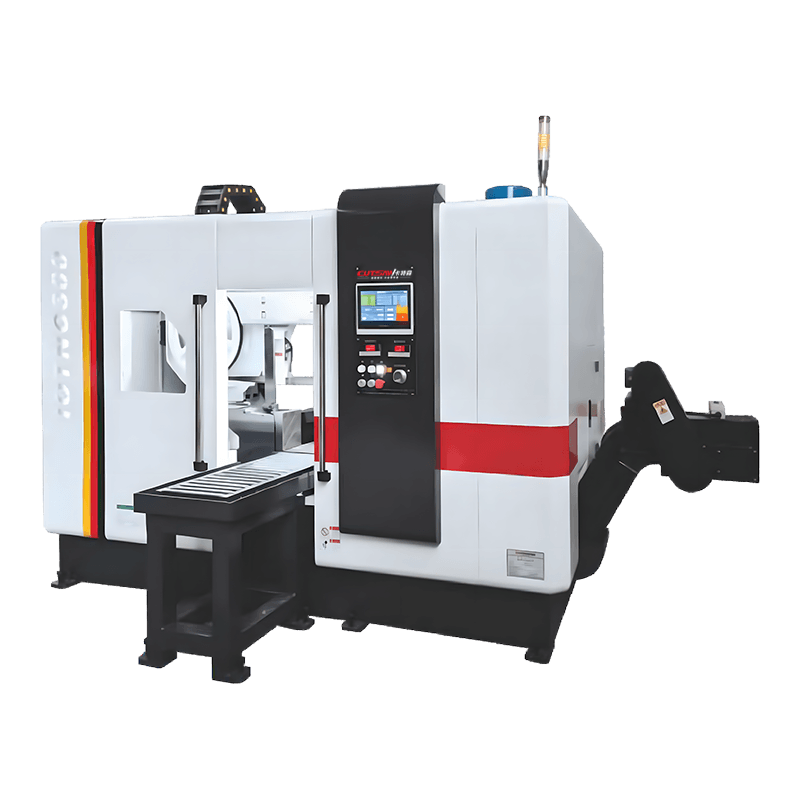
That distinction matters when the cut list becomes more varied rather than more repetitive. An automatic-feed CNC band saw such as the KT330Z brings a linear bar feed, automatic clamping and programmable cutting length into a compact frame — a natural long-run machine beside an existing pneumatic saw, which keeps handling short runs and odd diameters.
We kept the pneumatic saw for short runs and moved the high-volume work to a hydraulic machine. La consommation de lames a chuté d’un tiers en deux mois. — Responsable de production, usine de meubles en acier
What a Serious Supplier Should Be Able to Show You
Les brochures décrivent la machine ; l'atelier le définit. Ask the supplier to run a test cut on your actual pipe grade and wall thickness and record the end-face quality and cycle time. Ask for the air consumption figure in litres per minute, not just a pressure rating. Confirm the clamping stroke against the full range of pipe diameters you intend to cut.
Manufacturers with a complete line — from semiautomatic hydraulic saws to servo-driven CNC models — can usually advise honestly about which architecture fits, because they are not limited to one machine type. ISO 9001 and CE documentation are entry requirements, not differentiators.
Before you sign: run a test cut on your material, confirm compressor capacity, check clamp stroke against your pipe range, request the manual and CE declaration, and verify spare-part availability and blade delivery time.
Choose the machine whose air, blade and clamping conditions are designed as one system. Start from the cut list rather than the brochure: count the daily cuts, measure the wall thickness, and test the compressor before comparing prices. Do that, and a pneumatic automatic steel pipe sawing machine will earn its floor space — and the next machine you buy will be an upgrade rather than a repair.